Tampilkan postingan dengan label Spark. Tampilkan semua postingan

Rabu, 26 Desember 2012

Reality and Dreams - Muriel Spark

I'm away with my family for a few days, out of range of internet - the vicar escaping, post-Christmas Day!  I've scheduled some posts to appear, but I shan't be able to reply for a bit - and hopefully I'll be back with internet in time to write a post about the only one of my Century of Books that I've not yet finished!

If you were thinking that I'd had enough of Muriel Spark during Muriel Spark Reading Week, then think again!  One of the final books I've read in 2012 is her last of the 20th century, and third last overall - Reality and Dreams (1996).

Tom Richards - presumably a deliberately bland name - is a famous film director.  The first line of the novel, and thus the line which kicks off our impression of him, is archetypical Spark: 'He often wondered if we were all characters in one of God's dreams.'  And, with Spark's panache for combining surreality with restraint, she goes no further with that paragraph.  It hangs, so strangely, and we are shepherded straight to the second paragraph - where we learn that Tom Richards is recovering in hospital, having fallen out of a crane whilst directing a scene.  He broke nearly all his bones, but is lucky to be alive.

For the first few pages, reality and dreams swirl, as Tom fades in and out of lucidity.  I often have problems with the ways in which authors try to convey any mental distortion - whether disorientation or illness - as it usually seems clumsy and heavy-handed, or simply unreadable.  Spark, reliably, does it brilliantly.  Even something as simple as this conveys the disjointedness of time:
She poured out some milky tea.  He opened his eyes.  The tray had disappeared.
And then the complicated family arrive.  His wife Claire is patient and unshockable - and has affairs as often as he does, quite casually.  There is his angelically beautiful, but unvivid, daughter from his first marriage (Cora), and stolid, moaning, unattractive daughter from his current marriage (Marigold).  And there is the squabbling, self-absorbed cast of his film, originally called The Hamburger Girl - inspired by a brief sighting of a young woman at a campsite, who captivated Tom.

The various marriages in the family (some disintegrating), the cancelled and re-commissioned film production, the disappearance of one of his daughters and ensuing police search - all come together and interweave, creating a curiously mixed structure.  I think one of the most distinctive qualities in Muriel Spark's writing is that everything is always on the same level.  She refuses to get overly-dramatic about anything - possible kidnap and murder is treated in the same matter-of-fact way as Tom's physiotherapy, or the workings of the film shoot.  For it is, of course, the sphere of cinema which influences Spark's title:
that world of dreams and reality which he was at home in, the world of filming scenes, casting people in parts, piecing together types and shadows, facts and illusions
Apart from the mental disorientation at the beginning of the novel, there is never any wider suggestion that reality and dream might have been exchanged - but there is the possibility that fictitious events are starting, in a distorted way, to become true.  It's never overdone, but is a clever thread through a clever novel.  It's all quintessential Spark, and a perfect reminder of why she's one of my favourite authors.

Jumat, 27 April 2012

Two More Sparks: The Abbess of Crewe and The Takeover

A couple more Spark novels this morning; later in the day I'll put up a more general post with some questions looking back over Muriel Spark Reading Week for y'all.

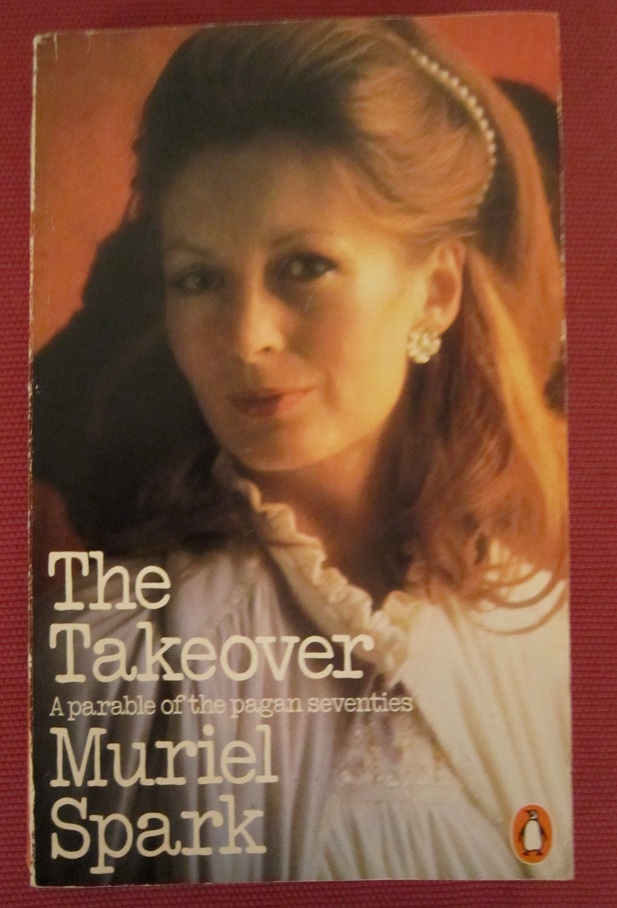
I decided to try and cover some of the Spark titles which others haven't read this week, and so in the past couple of days I read The Abbess of Crewe (1974) and The Takeover (1976) - consecutive novels from around the middle of Spark's writing career.  Turns out others have now posted about The Abbess of Crewe (including my own mother), but I'm still alone on The Takeover.  Or The Take-over, sometimes.  But Chris won a copy in my very brief competition on Facebook, so perhaps I won't be alone for so long.  Victoria/Litlove wrote in her excellent post that she's seen a lot of people this week say "this isn't one of Spark's best."  I'm delighted to say I've seen equal amounts of "this is my first Spark novel and I love her!" but, for these two novels, I'm going to have to say... they're not Spark's best.  But Spark's sub-par is still rather wonderful.  Onto the books.

The Abbess of Crewe is, the cover of my rather ugly edition informs me, a satire on the Watergate scandal.  (And, rather wonderfully, apparently a film starring Glenda Jackson called Nasty Habits.)  Now, I don't know a lot about the Watergate scandal, which happened over a decade before I was born, so Our Vicar gave me a quick rundown.  All I knew was that bugging was involved, and that seems to be the most salient detail for understanding the links with The Abbess of Crewe.  Who but Muriel Spark would transfer bugging and intrigue from politics to an abbey?  One which, indeed, uses both the Bible and Machiavelli's The Art of War.

Alexandra is the Abbess of Crewe at the start of the novella - after a chapter, Spark does her frequent trick of taking us back in time, to the period where Alexandra and Felicity both wish to win the 'election' for Abbess - supposedly without canvassing for votes, which is forbidden by abbey rules.  Alexandra is one of Spark's casually ruthless characters, without any strenuous sense of morality (which one might expect from a politician, but is amusingly strange from a nun).  She says wonderfully snarky/Sparky things like this:
"I don't deny," says the Abbess, "that by some chance your idea has been successful.  The throw of the dice is bound to turn sometimes in your favour.  But you are wrong to imagine that any idea of yours is good in itself."
Alexandra is not only determined to become Abbess, she is certain that it will happen.  Of course, the reader knows that it will - but it is curious that Alexandra is herself unswerving in this knowledge.  This sort of prelepsis is common in Spark, and always unsettling.  Another unsettling aspect is - and I can't think of other Muriel Spark novels where she does this - that The Abbess of Crewe is all in the present tense.  Usually that's a big no-no for me, but it works quite well here - because it gives the sense of constant surveillance.  And that's what's going on in the abbey: everyone's movements are recorded and observed, in the buildings and grounds.  And then there is the scandal caused by Felicity, and started by the theft of a thimble, alluded to in the first chapter, but rather a mystery to the reader...

My favourite character was one who was rather irrelevant to the plot - even in the slimmest of novellas (and this one comes in under 100 pages in my edition) Spark finds room for tangents, doesn't she?  Sister Gertrude is off in a far-flung corner of the globe, trying to convert cannibals, somewhere "unpronounceable, and they're changing the name of the town tomorrow to something equally unpronounceable."  She is called by telephone every now and then (somehow), is utterly unflappable, issuing the detached and bizarre aphorisms for which Spark is famous ("Justice may be done but on no account should it be seen to be done.")

The Abbess of Crewe is one of Spark's weirder books, and also one of the more amusing - on Thomas's wonderful Quirktensity Graph he puts it somewhere near the middle, but I'd put it in a very-quirky-not-very-intense position.  For people who know lived through the Watergate shenanigans, I imagine the whole thing would be even more entertaining - for me, it tipped the scales at a little too strange, but it was certainly the sort of novella nobody but Spark could have written.

* * * * *

The Takeover is probably my least favourite of the ten Spark novels I've now read - but it's still rather interesting, and good; everything is relative.  I intended this post to be brief, so I'll whip through The Takeover pretty speedily.  It's set in Italy and apparently (the cover again) it's a 'parable of the Pagan seventies', whatever that means.  Hubert and wealthy Maggie Radcliffe have parted ways; Maggie returns to the area with her new husband but Hubert refuses to leave her house, which is still filled with her furniture.  He busies himself secretly selling off her antique furniture and valuable paintings, replacing them with impressive fakes.  Oh, and Hubert 'considers he is a direct descendant of the goddess Diana of Nemi.  He considers he's mystically and spiritually, if not actually, entitled to the place.'  Here he is, in full Pagan action:
Again, standing one winter day alone among the bare soughing branches of those thick woodlands, looking down at the furrowed rectangle where the goddess was worshipped long ago, he shouted aloud with great enthusiasm, "It's mine!  I am the King of Nemi!  It is my divine right!  I am Hubert Mallindaine the descendant of the Emperor of Rome and the Benevolent-Malign Diana of the Woods..."  And whether he was sincere or not; or whether, indeed, he was or was not connected so far back as the divinity-crazed Caligula - and if he was descended from any gods of mythology, purely on statistical grounds who is not? - at any rate, these words were what Hubert cried.
That's a great example of how Spark writes her narratives: she does not interpret or judge, she simply presents the characters, their words and actions, and sits back to watch them.  In The Takeover, though, the stuff about Diana doesn't really seem too important until the final section.  Before that, it's all about money and lies.

There are plenty of characters - other neighbours, including Maggie's son Michael and his wife Mary; various effeminate ex-secretaries to Hubert; Pauline Thin, his current besotted secretary, etc. etc.  More or less all of them are concerned with embezzling from one another, without any sense of conscience-twinging going on anywhere.  That's one of the reasons I couldn't entirely get on board with this novella.  I'm used to Spark's characters being rather unapologetically ruthless - but here they are in the Evelyn Waugh school of selfishness.

The dynamics between Maggie and Hubert are interesting, as she tries unsuccessfully to takeover her own house, and there are certainly many moments of Spark's inimitable style ("How do you know when you're in love?" she said. / "The traffic in the city improves and the cost of living seems to be very low.") but I'm afraid on the whole I found it rather lacking in momentum.  Perhaps if I hadn't recently read several other Muriel Spark novels, and dozens of reviews, I'd have found the joy of reading her style sufficient - but the comparison has made me feel The Takeover a bit lacklustre.

So, a very brief review, I'm afraid.  I daresay one could write a lot about The Takeover, and if any of you are well-acquainted with 1970s Paganism, it would mean more.  For today's post I seem to have picked the two Muriel Spark novels which require the reader to have lived through the 1970s, don't I?  And interestingly, although both are ostensibly about religious activity, neither really have much to do with religion.  That's one of the few links I can see between these consecutive novels - except for both giving away huge plot twists long before they happen, in typical Spark style.

Of the five Spark books I've reviewed this week, I think her autobiography is my favourite - and, from the novels, I would choose The Only Problem, which keeps growing in my estimation since I finished it.  Later today, as I mentioned, there'll be a general discussion post - especially for non-blogging folk, but of course everyone else is welcome to comment too.  Keep posting your reviews, and letting me or Harriet know!  What fun!


Kamis, 26 April 2012

Curriculum Vitae - Muriel Spark's autobiography

Another Spark review from me - three books reviewed in one day, gosh!  Although this one I actually read during Muriel Spark Reading Week, and I'm writing about it down in Somerset - where the book group my Mum runs have all been reading Muriel Spark.  I joined in their lovely lunch, chatting about Spark - everyone enjoyed reading her, although one lady (who had read The Abbess of Crewe, apparently one of Spark's weirder novels) was rather bemused.  I'm hoping Mum will write some reviews of the Spark novels she's read this week... hint hint...!

Once I've read a lot of an author's novels, I like to look into their life a bit.  (You can do the same, very quickly, with Katherine's piece.)  I prefer doing it that way around - so that I have formed my own opinions from the books, and can use biographical information to augment my interest, rather than act as a starting point.  Martin Stannard's biography of Muriel Spark was looming in one corner of my room, but it's enormous, so I went to the horse's mouth - Spark's 'fragments of an autobiography', Curriculum Vitae (1992).

I had been curious to discover quite how Spark would write an autobiography, since her novels so often eschew normal narrative structures and the reliable narrator.  Not that her narrators are particularly unreliable - just the question of reliability seems to be rather sidelined.  Well, in Curriculum Vitae she is very concerned with reliability (I've typed that so often it doesn't feel like a real [reliable] word any more...) and refuses to trust her own memory: 'I determined to write nothing that cannot be supported by documentary evidence or by eyewitnesses'.  But there are definitely signs of Spark-the-novelist in the structuring of the autobiography.  Her usual trick of playing around with time makes an appearance, but it's the enticingly disjointed beginning which made me realise Spark-the-autobiographer was no real distance from Spark-the-novelist.  She starts by writing about bread, under its own little subheading.  And then butter.  And so on.  It's an interesting way to structure a childhood, but I don't think any other method would suit this most unconventional of novelists.

Spark grew up in beautiful Edinburgh, amongst family and neighbours who were fairly poorly-off, but with many strict manners and customs - although her own parents seem to have been pretty fun.  I can't summarise Spark's many details about this upbringing, but it demonstrates how incredibly observant she was from an early age - and who knows what she left out, because she couldn't find corroborating evidence?  There are definite signs of the latent novelist in Spark:
I was fascinated from the earliest age I can remember by how people arranged themselves.  I can't remember a time when I was not a people-watcher, a behaviourist.
A while later, whilst completing her education at Heriot Watt College, she notes:
I was particularly interested in precis-writing, and took a course in that.  I loved economical prose, and would always try to find the briefest way to express a meaning.
There, I think, you have the two keystones of Spark's novelistic power.  She is endlessly perceptive, and always concise.

In the early section of the autobiography, the part which was of most interest to me (and might well be to others) was on Miss Christina Kay ('that character in search of an author') whose teaching inspired Spark, and helped inspire her most famous creation, Miss Jean Brodie.  Of course they are not the same - Spark is too good a writer to lift people straight from life, even if that were possible - but they shared a love of educating girls, of Mussolini, and art.  Spark shows how she used Christina Kay, and where she invented.  Indeed, Spark often finishes an anecdote by mentioning which short story or novel the event helped influence.  The following excerpt is an example of this, but also of the way Spark writes her autobiography with the same unusual, out-of-kilter twists she presents so often in her novels:
Just round the corner in Viewforth lived Nita McEwen, who resembled me very much.  She was already in her first year at James Gillespie's School when I saw her with her parents, walking between them, holding their hands.  I was doing the same thing.  I was not yet at school.  It must have been a Saturday or Sunday, when children used to walk with their parents.  My mother remarked how like me the little girl was; one of her parents must have said the same to her.  I looked round at the child and saw she was looking round at me.  Either her likeness to me or something else made me feel strange.  I didn't yet know she was called Nita.  Later, at school, although Nita was in a higher class and we never played together, our physical resemblance was often remarked upon.  Her hair was slightly redder than mine.  Years later, when I was twenty-one, I was to meet Nita McEwen in a boarding house in the then Southern Rhodesia, now Zimbabwe.  There, our likeness to each other was greatly remarked on.  One night, Nita was shot dead by her husband, who then shot himself.  I heard two girl's screams followed by a shot, then another shot.  That was the factual origin of my short story 'Bang-Bang You're Dead'.
Perhaps I should elaborate on the self-confessed disastrous marriage which led to her life in (then) Rhodesia; her cunning escape back to Britain during World War Two; her hilarious account of working for the Poetry Society (which helped inspire Loitering With Intent); the various dramatic and often calamitous personal and professional relationships Spark had... but I want you to read Curriculum Vitae yourself, so I shan't.

Spark finishes this autobiography at about the time her first novel, The Comforters, was published.  She talks of a second volume, and it is such a shame that this volume never appeared - I would love to see her take on literary circles and the trappings of fame - but what Spark has written is wonderful enough.  Curriculum Vitae has all the energy and unusual qualities of a Spark novel, with the added joy of acting as a centre from which all her other works are spokes.  Once you've read three or four (or so) Spark novels, I recommend you hunt this down and see her bizarre take on real life - it's further evidence of her claim (I believe) to being one of the 20th century's greatest writers, and certainly one of its most original.

Rabu, 25 April 2012

Two Sparks: The Ballad of Peckham Rye and The Only Problem

Although I'm actually writing this in advance of Muriel Spark Reading Week, I'm confidently going to predict that we're all having a great time, and that you're all putting up brilliant, thought-provoking pieces on this wonderful novelist... yes?  Yes.

Since it's my day to post, I'm going to write fairly speedily about two Spark novels that I've read recently - and hopefully by the end of the week I'll have finished at least one more.  (There will be no shortage of Spark reviews around the blogosphere this week, but if you fancy reading all my archive posts on Spark, including this one, click here.)  I chose The Ballad of Peckham Rye (1960) because my supervisor said it might be a useful comparison to Lolly Willowes, and The Only Problem (1984) because it looked really interesting, and also one that I hadn't seen mentioned anywhere else in the blogosphere.  Cutting a long story short, I thought they were both brilliant - neither take the crown away from Loitering With Intent as my favourite Spark novel yet, but both add to my cumulative for Spark.  You'll be avidly reading Spark posts here, there, and everywhere, so I'll try to keep my reviews brief... and hopefully enough to intrigue you to read them!


The Ballad of Peckham Rye is centred, indeed, in Peckham Rye - and concerns the arrival and influence of one Dougal Douglas (sometimes going by the name of Douglas Dougal.)  The novel opens with the aftermath of a bride being jilted at the altar - indeed, with the bride's mother insulting the jilting groom.  It's all a little confusing (deliberately, one imagines) and it's difficult to get the story straight - especially since everyone is superimposing their views and imaginings over the facts.  The brief chapter concludes:
But, in any case, within a few weeks, everyone forgot the details.  The affair is a legend referred to from time to time in the pubs when conversation takes a matrimonial turn.  Some say the bridegroom came back repentant and married the girl in the end.  Some say, no, he married another girl, while the bride married the best man.  It is wondered if the bride had been carrying on with the best man for some time past.  It is sometimes told that the bride died of grief and the groom shot himself on the Rye.  It is generally agreed that he answered 'No' at his wedding, that he went away alone on his wedding day and turned up again later.
This is a great example of how Spark plays irreverently with the normalities of narrative.  And if the reader expects everything to be neatly unfolded by the end of the novel, then he/she clearly hasn't read much Spark before.  She obeys few authorial 'rules', and weaves her narratives with little concern for the reader's expectation.  If she were writing a play (and she has; I should read them) she would unveil Chekhov's gun in the first act, and nobody would ever lay a finger on it again.

But as someone notes on the first page of The Ballad of Peckham Rye, "It wouldn't have happened if Dougal Douglas hadn't come here."  She is quite right... although it is difficult to trace exactly how Dougal Douglas influences the community, his influence is undeniable.

He turns up somewhat out of the blue, and starts working at 'Meadows, Meade & Grindley, manufacturers of nylon textiles, a small but growing concern.'  His role is fairly vague.  Mr. Druce, the head of the company, is keen to hire 'an Arts man', and Mr. Druce places Douglas Douglas in charge of 'human research.'
"I shall have to do research," Dougal mused, "into their inner lives.  Research into the real Peckham.  It will be necessary to discover the spiritual well-spring, the glorious history of the place, before I am able to offer some impetus."
This research, it appears, chiefly constitutes attracting the workforce from their duties, calmly meddling in their lives, and undermining their confidences.  Dougal is all things to all people, and yet (although it is never asserted directly) it appears he might be an incarnation of the Devil.  He certainly has growths in his temple which rather resemble sawn-off horns - and the events which ensue from his presence have rather the hallmark of evil.

It is a fascinating concept, and one which has Spark written all over it.  She never gives us the certainty (as Sylvia Townsend Warner does in Lolly Willowes) that we are dealing with the Devil.  There isn't really certainty about much, for either the reader of the residents of Peckham Rye - but events spiral and, although the jilted bride is not the worst of the calamaties, it is a structural close to Dougal's presence and the circular narrative itself.  All is done with Spark's brilliant detached authorial voice, with doses of the surreal and strange interwoven with the commonplace and starkly observational.  Brilliant.

* * * * *

The Ballad of Peckham Rye was Spark's fourth novel; The Only Problem comes somewhere towards the end of her almost half-century of novelising - but they are unmistakably by the same author.  The concept is quite different, but the manner of approaching it is still very Sparkian.  I say that the concept is different, but thinking about it, these two novels both concern the nature of evil, in some way - though both rather skirt round the issue.

'The Only Problem' of the title is, according to Harvey Gotham, the problem of suffering.  Accordingly, he has taken himself off to the French countryside to write a monograph on the Book of Job, and his mind rarely wanders from this topic.  His own suffering seems to take the form of interfering relatives and his ex-wife Effie, whom he abandoned in Italy over a stolen chocolate bar.  The sort of premise which makes me know I'm in the delightfully odd world of Muriel Spark.

Amongst the cast are Effie's sister Ruth, and Ruth's husband (Harvey's old student friend) Edward.
Edward used to confide in Harvey, and he in Edward, during their student life together.  Harvey had never, to Edward's knowledge, broken any of these confidences in the sense of revealing them to other people; but he had a way of playing them back to Edward at inopportune moments; it was disconcerting, it made Edward uncomfortable, especially as Harvey chose to remind him of things he had said which he would rather have forgotten.
That is a very Sparkian relationship.  I can't think of any uncomplicated friendships in the eight Spark novels I've read - there is always some element of uneasiness or sharpness, or simply the failure to communicate naturally which characterises so many exchanges throughout her work.  I love conversations and plot expositions which subvert the normal rules in some way, or ignore the anticipated responses - it's on the reasons I love Ivy Compton-Burnett - and here is an example from The Only Problem.  There are some spoilers in it, so skim past if you want to avoid them:
Anne-Marie had put some soup on the table.  Harvey and Ruth were silent before her, now that she wasn't a maid but a police auxiliary.  When she had left, Ruth said, "I don't know if I'll be able to keep this down.  I'm pregnant."

"How did that happen?" Harvey said.

"The same as it always happens."

"How long have you known?"

"Three weeks."

"Nobody tells me anything," Harvey said.

"You don't want to know anything."
We aren't long in the cerebal world of theological exegesis.  Effie - it is claimed - has become involved in a terrorist organisation, and the police think that Harvey is also somehow implicated.  In vain does he protest (although never especially animatedly - Spark's characters tend towards the calm and detached) that he hasn't spoken to Effie for years.  The rest of The Only Problem follows this mad chain of events - Harvey calmly continuing to offer his readings of Job, while the police interrogate him and his wife's motives and actions remain mysterious.

Spark doesn't, however, permit the obvious parallels.  A lesser novelist (had they been able to think of the juxtaposition) would have used the wider action of the novel as an example of the problem of suffering.  Instead, like in all the novels I've read by her, Spark just lets things happen.  There isn't really any rhyme or reason, or grand overarching narrative point; there are no neat conclusions, just the brilliance of Spark's eccentric but observant writing.

So, two more gems to the Spark canon!  I'm so pleased Muriel Spark Reading Week gave me the encouragement to read more Spark.  Do continue to put links in the comments box, if you've reviewed a Spark novel or written anything about our Muriel - and I hope you're having a fun week!