Selasa, 17 Juli 2012

Five From the Archive (no.5)


I hope the Canadian bloggers among you don't mind my affectionate teasing in the sketch(!)  Although I've never been to Canada, I feel a certain affinity with that nation - we Brits (when we're not binge-drinking football fans) also radiate politeness (even when seething), and apologise when someone bumps into us.  Kate Fox's Watching the English is a brilliant read for this sort of thing, and will probably appear in a Five from the Archive at some point - but, for today...

Five... Books By Canadians.

1.) Too Much Happiness (2009) by Alice Munro

In short: A collection by one of the world's most acclaimed short story writers.  Munro examines many themes, but particularly death and intrusion.

From the review: "In playing with the short story genre, Munro invents a formless form appropriate to her superlative talent as an observer of human nature and human interaction."

2.) Literary Lapses (1910) by Stephen Leacock

In short: Very amusing sketches by an exceptionally gifted comic writer, not well known outside his native land.

From the review: "Stephen Leacock is a humorist par excellence. If I utter his name in the same breath as PG Wodehouse, it is not because their styles are all that similar (though both make fantastic use of stylistic exaggeration) but because Leacock is the only writer I would dare hold up to Wodehouse."

3.) Crow Lake (2002) by Mary Lawson

In short: A sister returns to visit her family, feeling guilty that she has studied for a PhD while her siblings have had to sacrifice their education... but things become more complex than that...

From the review: "Lawson writes with so many character nuances, and is concerned with subtle issues of empathy, sympathy, unity, hope, hopelessness, courage, foolishness, pride, misunderstanding - it's all there."

4.) The Penelopiad (2005) by Margaret Atwood

In short: A re-telling of The Odyssey from Penelope's perspective.

From the review: "The 'hook' of Atwood's narrative, though - a more original feminist viewpoint - is the death of Penelope's twelve maids. Odysseus apparently had them hanged upon his return from his voyage. I suspect this is a footnote in Homer's original, but Atwood plays it to its full potential, and it really is an ingenious angle: why were they killed, when they had aided Penelope?"

5.) Let's Kill Uncle (1963) by Rohan O'Grady

In short: A troubled orphan, Barnaby, is sent to a Canadian island and befriends a local girl, Christie.  Nobody would believe that Barnaby's kindly uncle is, in fact, a manipulative, evil man, intent on killing him.  Barnaby and Christie hatch a plan to kill the uncle first...

From the review: "When I read in the blurb that Donna Tartt had called Let's Kill Uncle a 'dark, whimsical, startling book', I was a little confused. Surely those words clash a bit when placed together? And I'm still not sure that there is much whimsy in the novel, unless you describe any scene without blood as whimsical - but it's certainly the lightest dark book I've ever read. Or possibly the darkest light book."

*  *  *

Over to you!  Which would you suggest?  (I chosen this 'five' theme because I've read so few Canadians - I imagine many of you would be able to suggest dozens.)

I should add that I loved The Stone Angel by Margaret Laurence, but apparently never blogged about it.  And, before you suggest it, I really did not like The Handmaid's Tale...


Senin, 16 Juli 2012

STW on VW


Sylvia Townsend Warner (photo source)

Sylvia Townsend Warner on Virginia Woolf

Diaries 26thJanuary 1942
‘At Boots Library the young woman put into my hands Virginia Woolf’s last book [Between The Acts].  And I received an extraordinary impression how light it was, how small, and frail.  As though it was the premature-born child, and motherless, and literally, the last light handful remaining of that tall and abundant woman.  The feeling has haunted me all day.’

Minggu, 15 Juli 2012

Coronation - Paul Gallico

God bless the Queen!  And God bless lovely Alice at Bloomsbury, who recently sent me a copy of Paul Gallico's Coronation (1962).  I wish I'd had this in my hands over the Jubilee weekend, because it would have made perfect reading.  It still made pretty darn brilliant reading this weekend.


Here's how the novel opens:
The wheels of the Coronation Special from Sheffield, due at St. Pancras Station at six o'clock in the morning of Coronation Day, 2nd June 1953, sang the steady, lulling dickety-clax, dickety-clax of the British Railways.  Approaching a crossing, the engine shrieked hysterically into the drizzly night as it pulled its heavy load through the countryside, London-bound.  In the third-class compartment occupied by the five members of the Clagg family and three other passengers, no one slept, though Granny kept nagging at the two children to try to do so because of the long exciting day ahead.
The Clagg family are absolutely adorable.  One can't help love them.  They are the every-family, so resolutely normal, and excited to be on this once-in-a-lifetime trip.  The Claggs are Will (salt-of-the-earth foreman at a mill, hard-working and kind, never quite as eloquent as he'd like) and Violet (slightly fraught wife, anxious to please her children and society equally), Violet's crotchety mother (known simply as Granny) and two children, Johnny and Gwenny (11 and 7 respectively.)  They're both rather lost in worlds of daydreams - for Johnny, it is the prospect of being a soldier (preferably one who dies to save the Queen - good man!) and for Gwenny it is princesses et al.  Not really challenging gender stereotypes, Mr. Gallico, but nobody could describe Coronation as a challenging book in any way.  No, it is instead a delightful whirlwind through the Claggs' day out in London for the Coronation, with occasional parallel glances towards the service itself.

The Claggs have managed, through Cousin Bert, to secure rather impressive tickets.  Initially 25 guineas each, they snapped them up for only £10 a piece (still rather a hefty sum in those days, of course - they have had a family vote to forfeit the annual seaside holiday in favour of the Coronation trip, despite Granny's moanings.)  The tickets include shelter, seating, and - to Violet's almost childlike excitement - champagne.  It isn't just the children who engage in daydreams; Violet is pondering how it will feel to be like a lady in the films, having champagne poured for her by a butler...

Over this first section of the novel, as the train speeds towards London, there is an undertone that, perhaps, things are all a little too good to be true...


I shan't spoil anything, but let's just say that things don't go entirely according to plan...

But this is not a dark tale like Gallico's (brilliant) Love of Seven Dolls, nor overly sickly-sweet, as I found Jennie.  Although it does have something of the structure of a fable, the utter believability of the Clagg family prevents it feeling like something Aesop would have penned as a moral warning.  Each member of the family has their vices and irritations, but you can't help desperately wanting good things to happen for them.  Creating one well-rounded, sympathetic, good-but-not-cloying character is impressive.  To give us five in one cohesive family, each yet different from one another, is sheer brilliance.

And then, of course, there is the Queen.  Although we don't see anything directly from her perspective, Gallico captures the love which many Britons (and others) felt towards the Queen - and which monarchists like me still feel: 'the journey to London was something very ancient in his blood, a drawing of himself as a loyal subject to the foot of the throne, a gesture, a fealty and a courtesy as well.'  It is too great a feat for me to put myself in the mind of a republican, but I'll go out on a limb and assume that you would still be able to love this novel for its delightfully accurate portrayal of family dynamics, not to mention Gallico's wit and sensitivity.

Oh, what a lovely little book it is!  It doesn't match Love of Seven Dolls for me, because I think that is a novel of very rare excellence, but, in a different mould, it is a sheer joy.  I raced through the novel in less than 24 hours, and I'm sure I'll read it again.  Hopefully for the Queen's 75th Jubilee!

To finish - it doesn't hurt that Bloomsbury have produced an exceptionally beautiful volume, with the incomparable David Mann designing the cover.  It's a special little book - and perfect to read in this Jubilee year.

(Long live the Queen)


Jumat, 13 Juli 2012

Chatsworth: the photos!

It's felt like quite a long week, and my energy levels are about up to posting a whole bunch of photos... so here are some snaps from my day at Chatsworth!  The weather wasn't great, but the company was, and the house and gardens are beautiful.  I didn't spend all that much time in the garden, but last time I went I spent more time in the garden than the house, so it evened out nicely (and this time Colin wasn't waiting in the car park!)  So... photo post ahoy!

This was the carriage they used at the
Coronation, I think -
included a great metal horse...

There is plenty of slightly unusual sculpture around -
this was probably my favourite bit.
Note the gilded balcony!

The order of service for the Coronation!

A whole Coronation room!  I was in Heaven.

Here we all are, standing looking regal on a staircase.
(l-r: me, June, Carol, Barbara - who has a blog)

Even on a gloomy day, not a bad view to have, eh?

For those who watched the BBC series, here's a close-up of the gilding...
I also saw the Head Tour Guide (whose story was in ep.1) walk past me.

A rather striking room - but, wait, what is that behind the door?

My dark, blurry photo doesn't really show it  -
but this is the most amazing piece of
trompe-l'oeil I have ever seen

My favourite part of a rather over-decorated house was this
beautiful wallpaper.  It might be a little overpowering 
if one had less capacious rooms, though...

The library!  It was actually very cosy.

Library Part 2.
Claire - how does this do on Library Lust?

Not, as June (I think) whispered, for a TV dinner...

The most wonderful baked cheesecake, which I ate in the cafe.

Into the garden - the spraying willow.

The gardens are a great mix of formal and unusual
- and I love steps anywhere.

From the highest point, looking across...

Just one of many separate sections, all with different characters

The house which supposedly made Elizabeth love Darcy(!)

Can't say I was wholly enamoured with the art in the grounds... 

No escape!  While waiting for my train at Chesterfield,
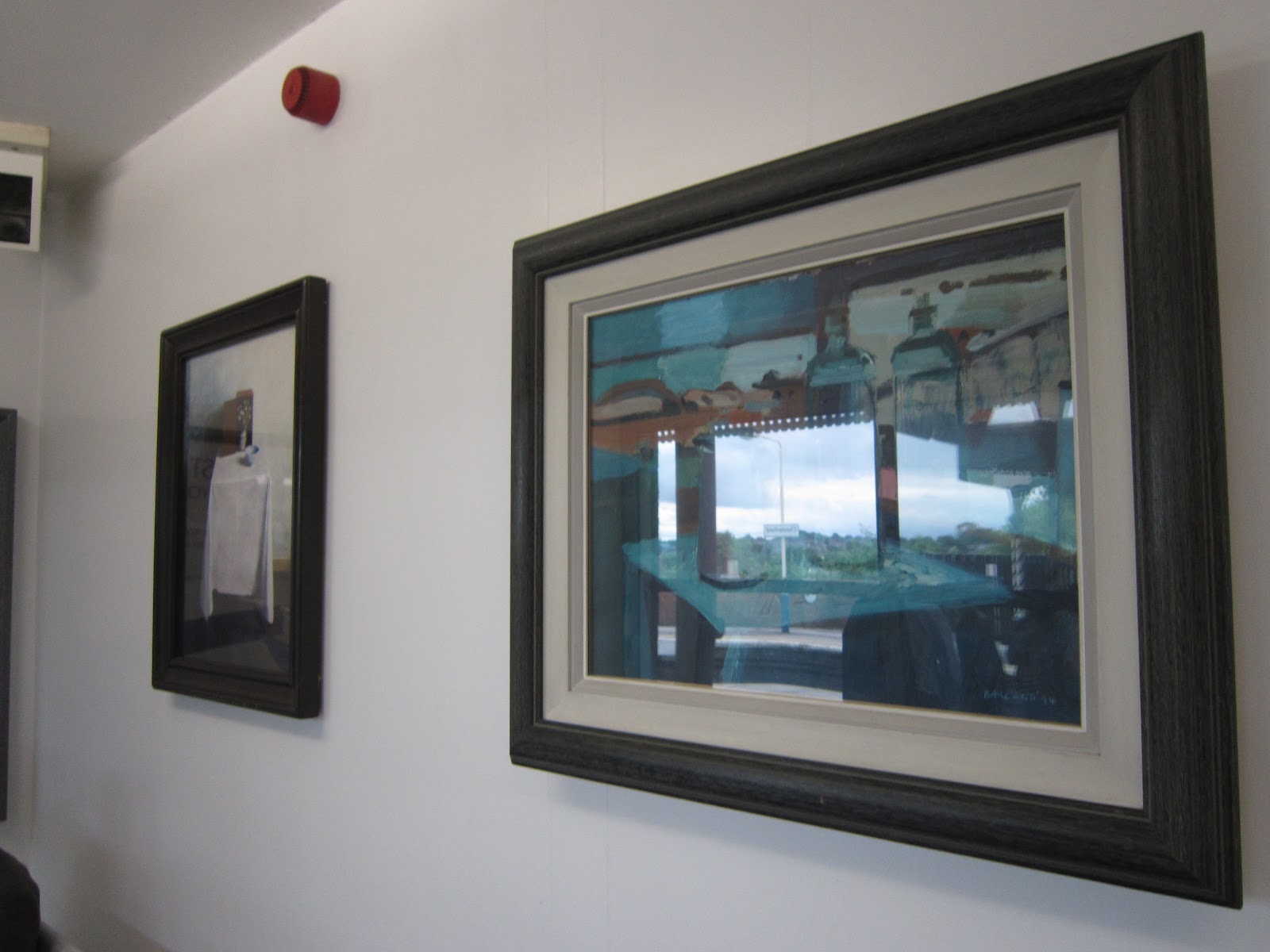
I saw that the Duke of Devonshire had donated
various pictures to the train station.

Rabu, 11 Juli 2012

A Room of One's Own - Virginia Woolf

I love Virginia Woolf.  Whenever I'm not reading her, I have slight doubts in my mind - is she really as brilliant as I remember?  Does a little bit of me just love Woolf because I think I ought to love Woolf?  And then I re-read one of her books, and realise that she is as brilliant as I remember - I find it very hard to believe that there is a better writer in the twentieth century.  Suggestions on a postcard.

Even those who wrinkle their noses at her fiction (listen up, Colin) tend to admire her non-fiction.  For my thesis I had the pleasure of re-reading A Room of One's Own (1929), bringing the total to three reads I believe, and it has confirmed my adoration of the book.  Many of us are probably familiar with its central tenet - that, in order to write, a woman must have a room of her own and five hundred pounds a year - but it is surprisingly how slim a section of the work this mantra occupies.  You might (like me) also recall Woolf recounting her experiences at an Oxbridge college, forbidden from using the library and chastised for walking on the grass.  And Judith Shakespeare, the playwright's hypothetical sister with equal talent but no chance of fame.  But these are only small elements within a much wider exploration of women through history, through literature, and in contemporary society.  Like most of Woolf's writing, she meanders (in the best possible way) from topic to topic, from thought leading to thought, so that one is at the end, far from where one started, without ever seeing the joins.  The whole essay (originally delivered as two talks, and edited into its current form) winds beautifully through so many thoughtful and striking ideas that to explore them all would be simply to type out the whole essay.

And how tempting that is!  I want to quote it all, to demonstrate the beauty and astuteness (in more or less equal measures) that Woolf fits into A Room of One's Own.  Woolf is so intoxicatingly good a writer that it feels almost an affront to write about her.  So I shall mostly quote.

Having been turned away from one library, Woolf (or, rather, the essayist - she is probably being playful with truth and personalities at times) takes herself to another, trying to discover what has been written about women by the scholars, theorists, and novelists.  That dry, sardonic, slightly self-deprecating wit that Woolf uses so often in her essays comes to the fore when reading a psychological tome (while doodling the author's face):
It referred me unmistakably to the one book, to the one phrase, which had roused the demon; it was the professor's statement about the mental, moral and physical inferiority of women.  My heart had leapt.  My cheeks had burnt.  I had flushed with anger.  There was nothing specially remarkable, however foolish, in that.  One does not like to be told that one is naturally the inferior of a little man - I looked at the student next me - who breathes hard, wears a ready-made tie, and has not shaved this fortnight.  One has certain foolish vanities.  It is only human nature, I reflected, and began drawing cart-wheels and circles over the angry professor's face till he looked like a burning bush or a flaming comet - anyhow, an apparition without human semblance or significance.
Her conclusions, after journeying through much that has been written in literature, history, and psychology, says (of course) more about the ways in which women have been treated in these fields than it does about women themselves:
A very queer, composite being thus emerges.  Imaginatively she is of the highest importance; practically she is completely insignificant.  She pervades poetry from cover to cover; she is all but absent from history.  She dominates the lives of kings and conquerors in fiction; in fact she was the slave of any boy whose parents forced a ring upon her finger.  Some of the most inspired words, some of the most profound thoughts in literature fall from her lips; in real life she could hardly read, could scarcely spell, and was the property of her husband.
As I say, there is far too much in A Room of One's Own to be able to do it all justice.  As an essay, it deserves and requires slow, careful reading and re-reading.  Woolf's writing is too rich for skimming.  I can only imagine how frustrating (as well as wonderful) it must have been to hear the lectures - to hear such genius (yes, I will use the word) and not be able to jot it all down for later!  How fortunate are we, to have the book readily available.  But amongst the many glorious elements of Woolf's essay, I perhaps loved most her journeys through women's writing over time:
For if Pride and Prejudice matters, and Middlemarch and Vilette and Wuthering Heights matter, then it matters far more than I can prove in an hour's discourse that women generally, and not merely the lonely aristocrat women generally, and not merely the lonely aristocrat shut up in her country house among her folios and her flatterers, took to writing.  Without those forerunners, Jane Austen and the Brontes and George Eliot could no more have written than Shakespeare could have written without Marlowe, or Marlowe without Chaucer, or Chaucer without those forgotten poets who paved the ways and tamed the natural savagery of the tongue.  For masterpieces are not single and solitary births; they are the outcome of many years of thinking in common, of thinking by the body of the people, so that the experience of the mass is behind the single voice.  Jane Austen should have laid a wreath upon the grave of Fanny Burney, and George Eliot done homage to the robust shade of Eliza Carter - the valiant old woman who tied a bell to her bedstead in order that she might wake early and learn Greek.  All women together ought to let flowers fall upon the tomb of Aphra Behn, which is,most scandalously but rather appropriately, in Westminster Abbey, for it was she who earned them the right to speak their minds.  It is she - shady and amorous as she was - who makes it not quite fantastic for me to say to you tonight: Earn five hundred a year by your wits.
So much of what A Room of One's Own addresses are battles that have been now won.  Woolf is not arguing about the numbers of female CEOs (why this is ever held up as a statistic, I can't imagine - how dreadful it must be to be a CEO!) she is arguing for women's education and entitlement to positions of intellectual credibility.  But one point did stand out to me, a battle which is still unwon:
This is an important book, the critic assumes, because it deals with war.  This is an insignificant book because it deals with the feelings of women in a drawing-room.  A scene in a battle-field is more important than a scene in a shop - everywhere and much more subtly the difference of value persists.
How many of us have heard this!  There are still (but how?) intelligent people who disregard, say, Jane Austen because she does not feature the Napoleonic Wars.  And many of our beloved middlebrow novelists fall victim to the same absurd views about what do and do not constitute viable literary topics.  This isn't as important as the battle for women to have university education (although sooner or later nobody, male or female, will be able to afford this, at the rate we're going) but it is a battle nonetheless.

However, I don't think one needs to be especially interested in feminist non-fiction to value A Room of One's Own.  I suppose, come to think of it, I am not especially interested in feminist non-fiction (however much I support the cause) because I've just realised that I haven't really read much else in this field.  What makes A Room of One's Own so sublime in my eyes is not Woolf's arguments and ideas, but her writing.  It flows so exquisitely; Woolf is so amusing and sharp, laughing at every turn, realising that aggression is far from the only way to make a point.  It is a book to read and re-read and re-read again - and a happy reminder that Woolf is not a writer for the elite or pretentious, but simply for those who admire ability, don't abhor thinking, and enjoy having a smile at the same time.  If you've not read it - oh, do, do, do!

Selasa, 10 Juli 2012

The Other Garden - Francis Wyndham

I had a lovely day at Chatsworth, even though all didn't go entirely to plan.  I'll fill you in on all that soon!  (WHAT a cliffhanger!)  For today, let's fill up one of those surprisingly-less-tricky-than-expected 1980s slots in A Century of Books.


I picked up The Other Garden (1987) by Francis Wyndham because I thought I'd heard of the author (and because it was short, cheap, and sounded interesting) but I must have been thinking of someone else, since this seems to have been Wyndham's only novel, although he also wrote (writes?) short stories.  It won the Whitbread First Novel Award, and various luminaries are printed on the cover saying that it 'Comes as close to perfection as you'll get in an imperfect world' (Hilary Bailey); 'Perfectly judged... wry, exact, poised' (Harold Pinter); 'A completely faultless piece of writing' (Susan Hill).  Well... it left me a little nonplussed.  Yes, this is going to be one of those rather uninspiring reviews where I am forced to say "It's fine, but that's about it."

I was, though, rather struck by the opening:
"How soon will lunch be ready?" my father would ask.  Assuming that hunger had made him impatient, my mother would answer with eager apology, "Oh, any minute now - it must be nearly one."  But she had misinterpreted him.  He had really wanted to know if he still had time for a further look at the other garden before sitting down to the meal.  In dismay, she would watch him put on an old grey trilby hat, choose a stick, pass purposefully through the front entrance, then walk serenely down the short drive and vanish into the open road.  Almost immediately opposite, a painted white wooden door in a red brick wall admitted him to this beloved extension of his property, subtly but certainly separate from the house and its bland surrounding lawns.  Once in the other garden he was safely out of earshot - but a few minutes later I would be sent in search of him with a summons to return, the serving of our good having been innocently hastened by his ambiguous question when what he had hoped for was delay.
This opening paragraph, and the title of the novel (novella?  It's super short) led me to think that The Other Garden might, indeed, be about this other garden.  Well, perhaps it was a metaphor for something (give me a moment) because it only turned up at the beginning and the end.  In between, it focuses mainly on the Demarest family, acquaintances of the narrator's family, albeit rather more well-to-do.  Kay and Sandy are the children, Sybil and Charlie are the Demarest parents.  The narrator (who may or may not be named) is focused chiefly on Kay, a young woman who is rather captivating and wilful.

And... I don't think I can remember much else.  There is a sweet dog at one point.  And Denis (a rather eccentric schoolfriend of the narrator) is shipped off to Switzerland for TB treatment.  He's odd.  What else?  Oh dear, oh dear.  I only read it recently, and all the details have faded.  It was that sort of book.  If I weren't recording all my books for A Century of Books, I'd have quietly slipped this back on the shelf, and never mentioned it...  But I did jot down one quotation which I liked.  Sybil generally isn't a very sympathetic character, but I think a lot of us would raise a glass to this:
"I do believe," Sybil continued, "that when the history books come to be written it will emerge that the great unsung heroine of these times we're living through will be none other than that much maligned creature, the British Housewife!  I'm thinking, in fact, of writing a letter to the Daily Telegraph to propose that some promising young sculptor - or perhaps a sculptress would be a better choice - should be officially commissioned to design a statue in her honour, and that the result should be prominently erected in some public place.  I don't know about you, but I for one am getting sick and tired of looking at monuments portraying middle-aged men on horseback!"
The details of The Other Garden escape me, but I do remember the effect it had upon me.  It's no secret that I love short books, and I really admire authors who can use 100-200 pages effectively.  But a novella demands its own structure.  The 'rules' for that aren't obvious - indeed, they don't exist, do they? - but I don't think a novella should be simply a truncated novel.  It felt like Wyndham's training at the short story had made him unable to structure a whole novel - I don't know, it just felt incomplete.  Not terminated too early, but as though it were the skeleton of a different, longer novel.  Somehow not satisfying. Hmm.  My post started fairly vaguely, and it'll end inconclusively.  It's probably a warning sign that, a week or two after I finished The Other Garden, I don't really remember anything about it.  But... don't forget that Hilary Bailey things it 'comes as close to perfection as you'll get in an imperfect world.'  So what do I know?


Senin, 09 Juli 2012

Chatsworth!

I'm off to Chatsworth for the day - I'll report back later!

And Janey, if you're still interested in Babbit, email me at simondavidthomas[at]yahoo.co.uk :)

Oh, whilst I'm giving brief notices - for those interested, I decided to change my Twitter handle from simonsiab (since people seemed confused over the 'siab' bit) to stuck_inabook - so I'm at Twitter.com/stuck_inabook.  One day I'll understand Twitter...

What else have I been up to?  I watched an episode of As Time Goes By tonight which I hadn't seen for ages, and chuckled away (the last episode in series 4, since you ask - a very enjoyable mockery of film sets.)

Have a lovely Tuesday, everyone!